
Bitcoin Custody Standard — Normative Summary
BCS-NS-1.1 · Version 1.1 · Public Standard · March 2026
The foundational document of the Bitcoin Custody Standard.
Abstract
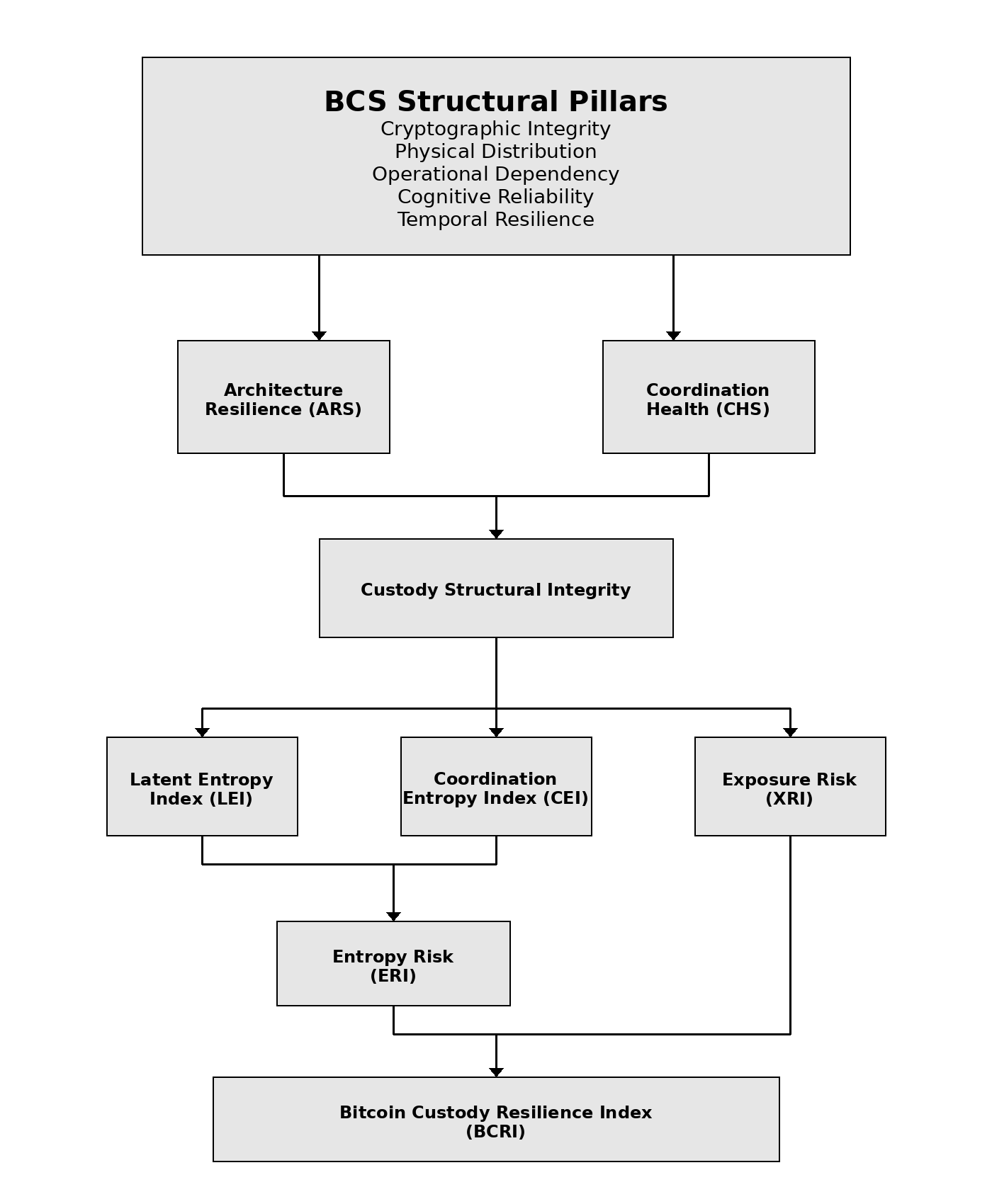
The Bitcoin Custody Standard (BCS) defines a normative framework for evaluating the structural resilience of Bitcoin custody architectures across time. The Bitcoin Custody Resilience Index (BCRI) is the quantitative assessment methodology aligned with BCS and used to measure custody resilience under the standard. The framework evaluates custody architectures across the five BCS structural pillars through the Architecture Resilience Score (ARS) while also assessing coordination health (CHS), entropy-related degradation (ERI), and adversarial exposure conditions (XRI). BCS is designed to operate alongside evolving institutional, regulatory, and technological custody frameworks while remaining structurally independent of jurisdiction-specific requirements and legal regimes.
Purpose
The Bitcoin Custody Standard (BCS) defines a normative framework for evaluating and strengthening the structural resilience of Bitcoin custody architectures across time. Custodial Entropy refers to the progressive structural degradation of custody systems as operational coherence erodes through knowledge loss, undocumented changes, technological evolution, coordination drift, and insufficient review.
Because Bitcoin is a bearer asset with no recovery possible once keys are lost, BCS exists to reduce the probability that Bitcoin holdings — whether managed by individuals, families, fiduciaries, advisors, or institutions — become permanently inaccessible due to preventable Custodial Entropy. BCS operates within Bitcoin's foundational constraint that ownership is defined by control of private keys.
The Bitcoin Custody Resilience Index (BCRI) operationalizes the BCS framework by providing structured measurement of architecture resilience, coordination reliability, entropy-related degradation, and adversarial exposure.
Core Principle
Bitcoin custody must be evaluated for resilience over time, not security at a point in time.
- Bitcoin Custody Resilience Index (BCRI): Composite resilience output (0–100, higher is stronger)
- Architecture Resilience Score (ARS): Structural strength across the five BCS pillars (0–100, higher is stronger)
- Coordination Health Score (CHS): Reliability of custody coordination and procedural continuity (0–100, higher is stronger)
- Entropy Risk Index (ERI): Long-horizon structural degradation risk (0–100, lower is better)
- Exposure Risk Index (XRI): Adversarial exposure and operational visibility risk (0–100, lower is better)
ERI and XRI are the primary risk indicators used for conformance evaluation. XRI does not independently determine conformance status but contributes to the overall resilience assessment.
← Swipe to explore →
All framework terms are defined in the BCS Definitions and Glossary — including structural pillars, measurement components, entropy theory, and conformance terminology.
Bitcoin Custody Standard (2026).
BCS-NS-1.1 — Normative Summary.
Available at: https://bitcoincustodystandard.org/normative-summary/
Embedded PDF viewing is not reliable on mobile browsers.
Open the full document directly for the best reading experience.